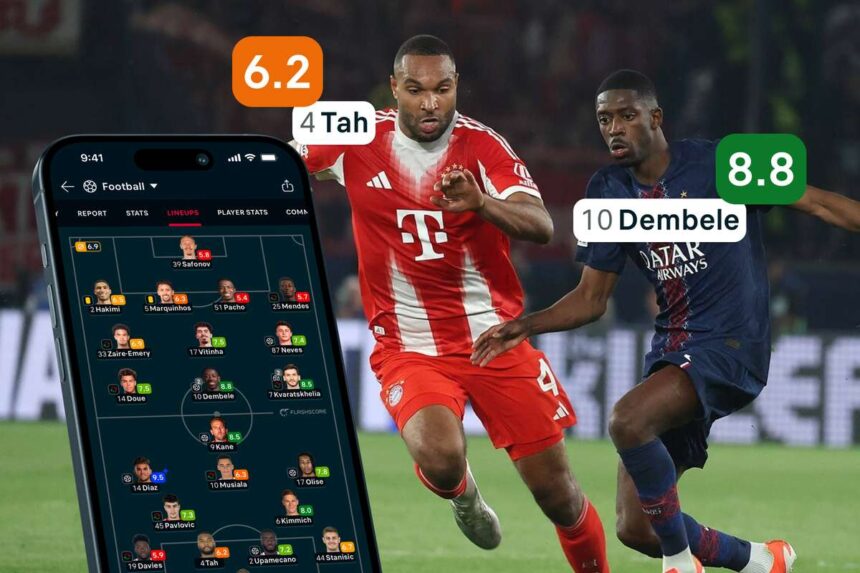
The New Flashscore Rating: Enhanced, Transparent, and Smarter Across Over 250 Leagues
For the past three years, users of Flashscore have become familiar with our football rating system. In our continuous effort to enhance user experience, we are excited to unveil the updated Flashscore Rating. This new system is crafted for both casual followers of the sport and those passionate about in-depth analysis, offering a comprehensive evaluation tool.
The revamped Flashscore Rating synthesizes over 70 individual statistics into a single grade. To be eligible for this grading, players must spend a minimum of 10 minutes on the pitch, with their ratings evolving as the match progresses.
Our new rating system operates on a fully automated basis, drawing from extensive historical performance data and powered by detailed Opta statistics. This means our evaluations maintain objectivity, eliminating any human bias. Our proprietary algorithm has undergone rigorous testing, involving insights from our internal experts and external assessments from renowned figures, including Premier League icon Petr Čech.
In-Depth Grading: Beyond Basic Metrics
The Flashscore Rating incorporates a multitude of contributions beyond mere goals and assists. Each player’s evaluation is tailored to their specific positions and roles within the team framework. Rather than merely adhering to lineup positions, we assess players based on their actual responsibilities on the field. This includes categorizing their functions into Defending, Progression, Playmaking, and Attacking roles, or combinations thereof, ensuring accurate reflection in their ratings.
This comprehensive and dynamic profiling guarantees that players are evaluated according to their genuine contributions to team success. For instance, a midfielder who specializes in defensive duties will not be evaluated using offensive statistics, promoting fairness in grading.
Game-Changing Moments and Player Abilities
We also value those pivotal moments that define matches and influence ratings, which enrich the overall scoring dynamics. Elements such as significant chances created or errors leading to goals are particularly instrumental in shaping a player’s rating. Furthermore, exceptional skills like dueling prowess or extraordinary dribbling capabilities play a vital role in the final assessment.
With these considerations, we introduce the new Player Card, providing users with all pertinent information to understand the context behind a player’s rating. This encompasses deep data analytics alongside key moments and standout attributes that culminate in the final score.
Defining Player Roles and Metrics
The categorization of player roles aids in delivering precise evaluations. The Goalkeeping role focuses on shot-stopping capabilities, analyzing both the volume of saves and the quality of goals prevented, alongside passing contributions and overall presence in goalkeeping duties.
The Defending role measures a player’s defensive contributions, focusing on successful tackles, interceptions, and recoveries, as well as effectiveness in aerial duels and shot blocks. The Progression role evaluates the player’s ability to advance the ball, analyzing both progressive passes and carries that propel the game toward opposing goals.
For the Playmaking role, emphasis lies on creating scoring opportunities, assessed via expected assists and key passes, while also considering entries into the penalty area and successful final third passes. The Attacking role hones in on the potential for goal-scoring, looking at expected goals, shot attempts, and engagement within the box alongside offensive duels.
By synergizing these classifications, we develop detailed player profiles. For example, a midfielder excelling in both Defending and Progression emerges as a ball-winning playmaker, while a player who combines Playmaker and Progression roles becomes a creative midfield orchestrator. This nuanced approach ensures that ratings genuinely reflect a player’s responsibilities and performance on the field.
Rating Enhancements: Positive and Negative Influences
Notably, certain actions influence players’ ratings positively or negatively. These include defining moments such as winning goals or crucial defensive tackles and detrimental actions like errors leading to goals or missed big chances. Furthermore, certain abilities, such as finishing and shot-stopping, can sway ratings based on performance against expected outcomes.
The Finishing metric assesses player efficiency in converting chances, highlighting the correlation between expected scoring opportunities and actual outcomes. Meanwhile, Shot Stopping gauges goalkeepers’ effectiveness against the quality of shots faced, acknowledging whether they over-perform or underperform against expectations.