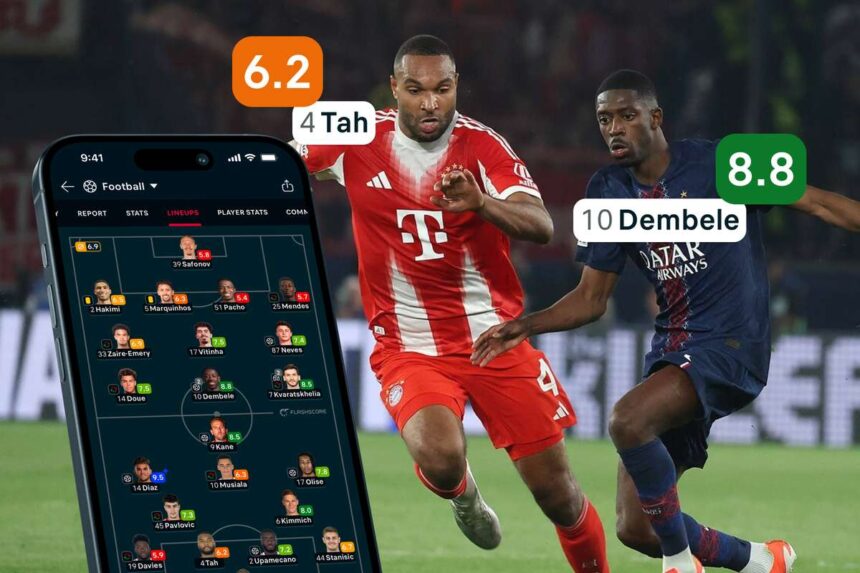
Introducing the New Flashscore Rating: A Revolutionary Leap in Sports Evaluation
Flashscore has consistently been at the forefront of sports analytics, and after three years of refining its football rating system, the platform is thrilled to unveil the enhanced Flashscore Rating. This innovative approach aims to provide an all-encompassing evaluation for both casual and dedicated fans, ensuring it meets the diverse needs of its user base.
The Framework Behind the Rating
The new Flashscore Rating synthesizes over 70 different statistics into a singular score that reflects a player’s performance on the field. To ensure a fair assessment, a player must be on the pitch for a minimum of 10 minutes to receive a rating, with scores dynamically adjusting as the game progresses.
Utilizing advanced algorithms, the Flashscore Rating is fully automated and benchmarked against historical performances. It leverages comprehensive data from Opta, providing an objective analysis devoid of human bias. This meticulous process has been validated by experts including Premier League icon Petr Čech.
Beyond Basic Metrics
What sets the Flashscore Rating apart is its multifaceted approach to player evaluation; it considers various aspects beyond simply goals and assists. Players are assessed based on their specific roles on the pitch, such as Defending, Progression, Playmaking, or Attacking, with their responsibilities influencing their rating. This depth of analysis ensures that every player’s contribution is accurately represented, meaning, for example, a defensive midfielder will be evaluated for their defensive actions, not their attacking input.
The New Player Card
The culmination of this innovative rating system is the newly designed Player Card. It encapsulates all relevant data necessary for fans to understand the rationale behind a player’s score, showcasing key moments, performance metrics, and standout abilities that contribute to the overall rating.
Defining Player Roles
Flashscore has defined distinct player roles for precise profiling, ensuring a comprehensive evaluation:
- Goalkeeping Role: Specifically for goalkeepers, this measures shot-stopping abilities, taking into account saves, goals prevented, and their contribution to playing out from the back.
- Defending Role: Captures defensive efforts through metrics like tackles, interceptions, and aerial duels.
- Progression Role: Credits players for advancing the ball towards the opponent’s goal, with emphasis on progressive passes and carries.
- Playmaking Role: Focuses on chance creation through expected assists and key passes, reflecting a player’s impact in critical areas.
- Attacking Role: Evaluates a player’s offensive threat via expected goals, shots, and actions inside the box.
Game-Changing Moments and Influences
Player ratings are further influenced by special moments—both positive and negative—within a match. Noteworthy events such as winning goals or significant defensive tackles positively impact the rating, while errors leading to goals can detract from it. Additionally, exceptional skills like dueling prowess can significantly influence a player’s final score.
Evaluating Finishing and Shot Stopping
Two specific metrics that can influence ratings in both directions are Finishing and Shot Stopping. Finishing evaluates a player’s ability to convert scoring opportunities relative to the quality of chances they receive, while Shot Stopping measures a goalkeeper’s effectiveness in saving shots against the quality they face.
Conclusion
The new Flashscore Rating represents a significant advancement in sports analytics, providing a fair, transparent, and intelligent evaluation method. With comprehensive role definitions and a focus on impactful moments, Flashscore ensures that every player’s contributions are both recognized and fairly assessed.