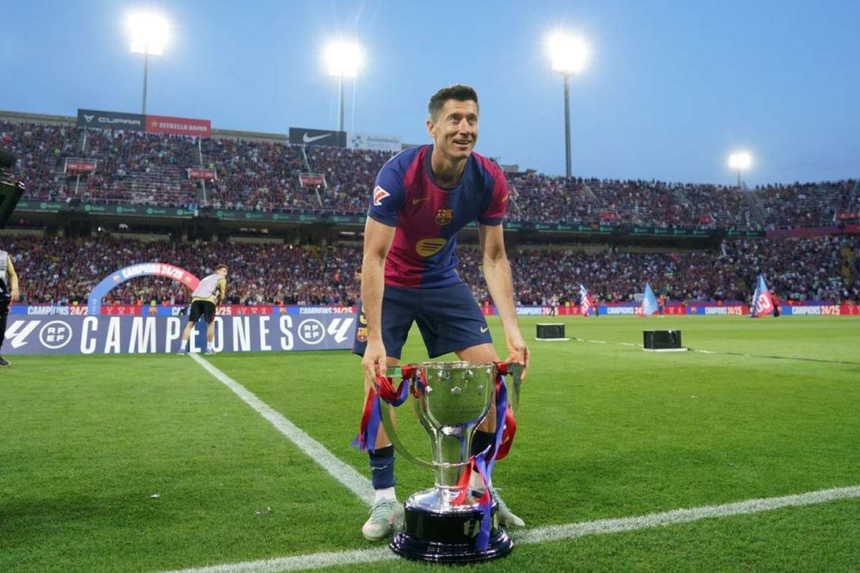
Lewandowski’s Bitter Forgetting of Premier League Glory
In a universe where fleeting opportunities can define legacies, Robert Lewandowski’s admission about a botched move to Manchester United in 2012 exposes the sobering failures lurking behind glimmering ambitions. Once tethered to Borussia Dortmund, Lewandowski had his dreams spirited away by the greed-fueled machinations of club executives who saw a chance to fatten their coffers rather than nurture one of their brightest stars.
Desires Drowned by Corporate Greed
Lewandowski, yearning for an audience with the legendary Sir Alex Ferguson, recognized the allure of the Premier League as he branded his aspirations with the desire to don the iconic red jersey of Manchester United. “To Manchester United, I decided and said yes,” he reflects, his words echoing a sentiment that was summarily dismissed by those blinded by financial gain. “They could not sell me,” he laments, a stark commentary on how commerce trumps the artistry of sport.
Unfulfilled Potential or Strategic Delay?
What might have been an illustrious chapter in Premier League history quickly morphed into a symptom of a systemic ailment within football—clubs that care more about their bank balance than the potential of individual brilliance. Lewandowski, now 37, stands not as a player who laments his lost opportunity but as a testament to how a player can thrive despite being anchored by the heavy chains of corporate decisions. His journey through Bayern Munich and Barcelona reveals that sometimes, escape from the stifling protocols of one’s club can lead to soaring heights unimagined within the confines of stale negotiations.
Regrets? A Reluctant Reflection
“Maybe it could be a regret,” he articulates with a hint of nostalgia, juxtaposing the wealth of experiences against the haunting specter of ‘what ifs.’ But deeper contemplation unveils that for Lewandowski, significance hinges not on regrets but on the relentless pursuit of passion and fulfillment. “I don’t have this kind of feeling that I missed something,” he asserts, a stark reminder to all players caught in the web of speculation and agency. His narrative showcases the importance of being the architect of one’s destiny rather than allowing it to be dictated by external forces.
The True Essence of Fulfillment
As Lewandowski reflects on his decorated career, one can’t help but ponder whether the corridors of football are governed by a bitter irony—where one man’s loss is another’s opportunity. In his illustrious trajectory, he has managed to thread the needle of destiny with a distinctive flair, demonstrating that happiness in sport is less about the clubs on a resume and more about the echoes of one’s own choices reverberating through time.
Conclusions Embedded in Half-Hearted Deals
In the grand theater of football, where talent and ambition collide with the cold realities of business, Lewandowski’s near-miss with Manchester United serves as a grave cautionary tale. It emerges as a symbol of the relentless quest for power and profit over passion—of decisions made not in the spirit of the game but under the harsh light of fiscal logic. Ultimately, as long as the beautiful game is held captive by avarice, it will continue to choke on the dreams of many talented players who could have rewritten history but found themselves erased from its pages by those counting their riches.
Source: Flashscore News