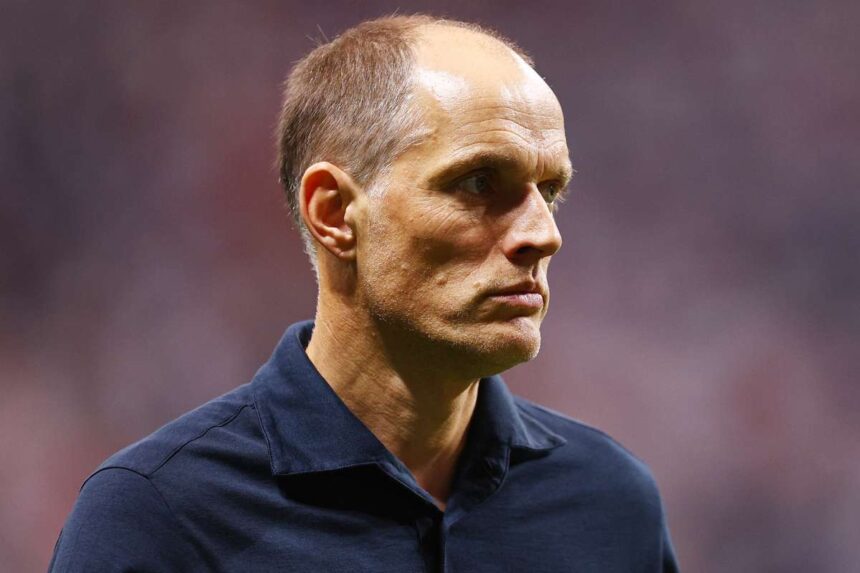
Opinion: Tuchel’s Inauguration as England Manager Falls Short Against Argentina
The primary basis for Thomas Tuchel’s selection as England manager was his distinction from Gareth Southgate, with the renowned German coach being brought in to guide the Three Lions past the barriers that had stalled them in the previous five tournaments. However, in a critical moment on Wednesday night in Atlanta, Tuchel surprisingly mirrored Southgate’s cautious approach when it mattered most, disappointing England supporters.
The Football Association (FA) made a substantial investment in hiring a Champions League victor, a coach who had previously outmaneuvered Pep Guardiola in a European final, largely because Southgate’s England consistently faltered on the biggest stages. The expectation was never merely to reach a semi-final, which Southgate had previously accomplished; rather, the aim was to win the pivotal match—the one where managing a lead against elite opponents becomes essential, and where a manager’s tactical choices can tip the scales.
A candid evaluation of England’s journey leading to this point sheds light on their overall performance. England traversed their tournament path with commendable resilience, but without a singularly impressive display. They managed to secure victories in challenging conditions, such as overcoming ten men at altitude in the intimidating Azteca Stadium, before squeezing past Norway in a quarter-final that required extra time, a performance that prompted Tuchel to publicly express his dissatisfaction with his players.
Over six weeks, England notched five wins and a draw, yet they did not demonstrate a level of play that instilled fear in any remaining contenders. This is acceptable when progression is the goal, and like Argentina in their 2022 group stage campaign, the specifics of earlier matches are typically forgotten. Nevertheless, the semi-final held monumental significance for the Tuchel project, as it was intended to transform the laborious performances into a level of success that had eluded Southgate.
For the first hour, England executed their game plan admirably. Their pressing was remarkably effective; Anthony Gordon notably pressured Emiliano Martinez three times within the first four minutes. Following a rough first half devoid of shots (a phenomenon not witnessed in a World Cup since at least 1966), England maintained a firm grip on the game’s pace. Notably, John Stones and Marc Guehi completed all of their first-half passes, with expected goals suggesting a marginal advantage for England at halftime.
However, after Gordon scored in the 55th minute, England’s strategy appeared to falter. Instead of maintaining their approach, they seemingly handed control, inviting a technically superior Argentina to dictate the pace.
Substitutions that Backfired
After taking the lead, England managed a mere 17% possession, with nine touches in Argentina’s half during the subsequent quarter of an hour. Rather than reinforcing their advantage, Tuchel opted to pull Gordon, the goalscorer and key attacking threat, in place of defender Ezri Konsa. By this point, the English team had already been forced into 26 clearances since the goal was scored.
The substitutions did not achieve their intended effect. While the threat from Argentina escalated, including a shot from Nico Gonzalez that necessitated Jordan Pickford’s first significant save, Tuchel’s response was to fortify his defense with additional players who ultimately lacked impact. Konsa failed to reclaim possession even once and struggled during critical moments. The introduction of Dan Burn added little, and by the final seconds of the match, England’s reconfiguration had allowed them to concede even further.
The statistics from this passage of play paint a bleak picture: England managed only two passes between the 66th and 86th minutes, constituting little more than a desperate signal for help. Meanwhile, Argentina, underlined by decisive adjustments, seized control of the match, emphasizing their dominance in ball possession.
The Dominance of Messi
As England receded, the opportunity was significantly capitalized on by Lionel Messi. The Argentine superstar achieved remarkable feats, completing nine dribbles and providing two assists—the first player to note such a distinction in a single World Cup knockout match since records began. In stark contrast, the entire England team combined for only seven successful dribbles. Messi’s striking contributions led to the equalizer and subsequently to the game-winning header by Lautaro Martinez.
The poignant observations from Emiliano Martinez, Argentina’s goalkeeper, underscored England’s psychological decline post-Gordon’s goal. Martinez noted that England began to retract rather than press forward, indicating their hesitation. Similarly, Argentina’s manager Lionel Scaloni stated that England appeared to doubt themselves, seizing an opportunity to dominate.
Tuchel’s Defense and Missing Opportunity
In the aftermath, Tuchel defended his strategy, asserting that the match dynamics shifted beyond his structural adjustments and that England’s inability to maintain possession was a significant concern. His assertion holds validity, yet it essentially condemns his choices further; a coach who identifies a loss of competitive edge but substitutes his most dynamic presser and ball-winner ultimately exacerbates the problem.
The pattern illustrated here is not novel for England—a recurring theme of surrendering leads in crucial matches has emerged. As they grapple with their past failures amid high-stakes competitions, the stakes surrounding Tuchel’s tenure will only escalate moving forward.
With Harry Kane nearing the latter stages of his career and this being his fifth major tournament where he fell short of the pinnacle, England’s current squad finds itself at a crucial juncture. Although players like Jude Bellingham represent a younger generation with potential, they may not replicate the favorable circumstances seen in this tournament. Being in a strong position against Argentina with ample time remaining was perhaps the closest England might come to realizing their dreams for some time.
Future Outlook
Tuchel, brought in with high expectations, matched the previous baseline set by his predecessor without seizing the higher aspirations associated with his role. The FA may retain him until the home Euros, hopeful he will assimilate lessons not captured by the last manager. However, the apparent revolution under his guidance risks being viewed merely as a change in branding. Unlike Gareth Southgate, who exhibited visible distress following similar failures, Tuchel refrained from recognizing the potential missteps that characterized this match.
The 2026 World Cup Awaits
The 2026 World Cup is set to take place from June 11 to July 19 in the United States, Canada, and Mexico, featuring an expanded tournament with 48 national teams across 16 modern stadiums, opening new avenues for footballing nations to strive for glory. As England reviews their latest missteps, they must also orient their sights toward this upcoming challenge.