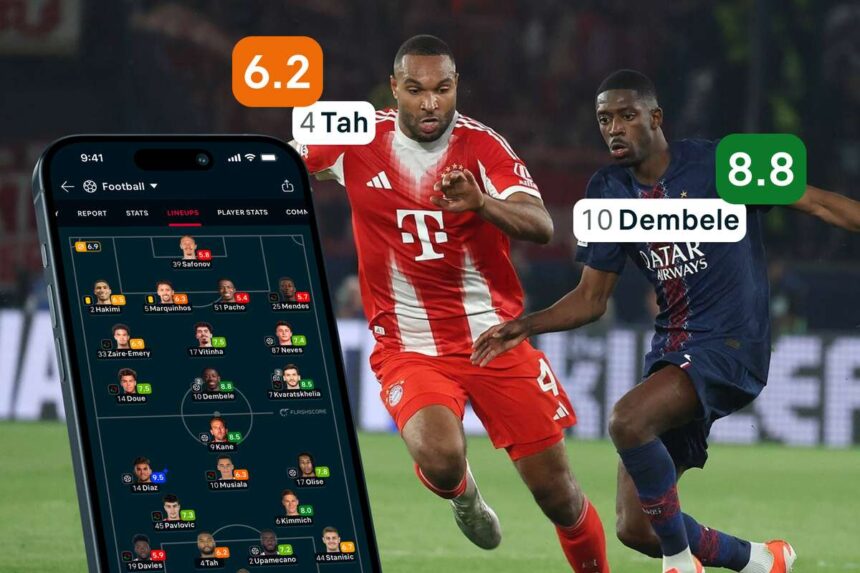
THE NEW FLASHSCORE RATING: FAIR, TRANSPARENT AND SMARTER THAN EVER IN MORE THAN 250 LEAGUES
Flashscore has long been a go-to platform for fans and users interested in football ratings, and after three years of refining its offering, the service proudly introduces an enhanced version of the Flashscore Rating. This new rating is designed to meet the needs of both casual fans and those who thrive on detailed analytics, providing a comprehensive evaluation of player performances.
Overview of the New Flashscore Rating
The latest iteration of the Flashscore Rating integrates over 70 distinct statistics to derive a single grade for each player. To receive a grade, a player must spend a minimum of 10 minutes on the field, with their rating progressively adjusted as the match unfolds. This system relies on fully automated processes, which have been meticulously benchmarked against historical performance and fortified by Opta’s extensive data, ensuring objectivity and the elimination of human bias.
Algorithm Development and Expert Testing
Developed through proprietary algorithms, the new Flashscore Rating has undergone rigorous testing by both internal experts and external authorities, including Premier League legend, Petr Čech. This collaborative approach solidifies its credibility while enhancing its precision.
Detailed Evaluation Criteria
The Flashscore Rating expands its criteria beyond mere goals and assists. Each player is assessed according to their designated role on the field, considering defensive, progression, playmaking, and attacking responsibilities. Consequently, players are not unfairly penalized or rewarded based on the statistics that do not pertain to their specific roles. For instance, a midfielder known for breaking up plays will not be evaluated on offensive metrics.
Dynamic Player Profiling
This intricate profiling guarantees that players are evaluated on their actual contributions to the team. The rating considers critical moments in the game, such as opportunities created or mistakes leading to goals, alongside traditional statistics. Exceptional skills, like duel dominance and superior dribbling, also influence the final grade considerably.
Advanced Player Cards
The culmination of this analytical framework is showcased in the new Player Card, where users can delve into comprehensive details surrounding a player’s rating. This card includes contextual data, pivotal moments, and notable attributes that culminated in the final assessment.
Classification of Player Roles
As part of the rating system, players are categorized into specific roles that guide their evaluation. The Goalkeeping role focuses on shot-stopping capabilities, measuring both quantity (saves) and quality (goals prevented), along with additional variables like passing ability and judgment in play. The Defending role assesses contributions to defensive efforts through tasks such as tackles and interceptions, while the Progression role rates how effectively players advance the ball towards the opponent’s goal. The Playmaking role zeroes in on actions that create high-value scoring opportunities, and the Attacking role evaluates the direct threat to the goal, enriching the rating with context from numerous offensive actions.
Impact of Game-Changing Moments
Crucial game-changing moments and player abilities are factored into the overall rating. Positive game-changing events can enhance the grade, whereas negative aspects, such as errors leading to goals, could detract from a player’s score. Additionally, players’ finishing and shot-stopping skills can significantly influence their overall evaluations based on their efficiency in high-pressure situations.
Conclusion
With the launch of the new Flashscore Rating, football fans can now enjoy a more nuanced and fair assessment of player performances that truly reflects each individual’s contributions on the pitch. This initiative not only enhances the viewing experience for fans but also sets a new standard in sports analytics.