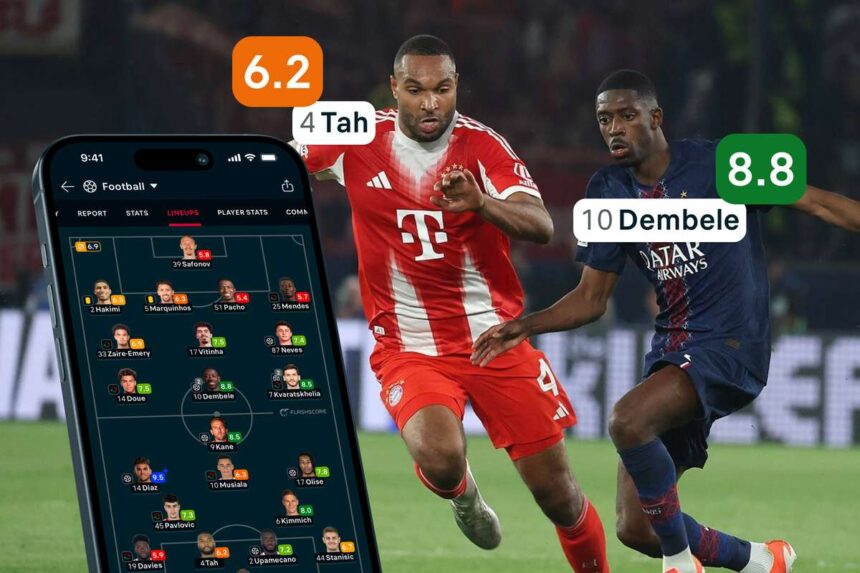
Introducing the New Flashscore Rating: A Game Changer in Sports Analytics
As a dedicated platform for sports enthusiasts, Flashscore has continuously evolved over the years, and now we are thrilled to unveil the next iteration of our standard: the New Flashscore Rating. This comprehensive evaluation tool integrates insights from over 70 different statistics, enhancing the experience for both casual viewers and data aficionados. With rigorous updates rolling out across more than 250 leagues, players and fans alike are in for an enlightening treat.
Understanding the Rating System
The New Flashscore Rating is designed to deliver an objective and nuanced assessment of player performance. To merit a grade, players are required to be actively participating in the match for a minimum of 10 minutes. The grading scale adapts throughout the match, creating a dynamic reflection of performance as the game progresses.
Our state-of-the-art algorithm harnesses deep Opta data, with no human bias interfering in evaluations. The development of this rating involved extensive testing with our in-house expertise, coupled with insights from esteemed figures in the football community, including Premier League legend Petr Čech.
A Comprehensive Approach to Player Evaluation
What truly sets the Flashscore Rating apart is its multi-faceted approach to assessing player contributions. While traditional metrics such as goals and assists are crucial, our new rating considers a player’s actual responsibilities on the pitch, which may greatly diverge from their designated position in the lineup. Players are grouped into specific roles—Defending, Progression, Playmaking, or Attacking—ensuring that each individual is evaluated within the context of their actual contributions.
This nuanced profiling guarantees that players are assessed fairly; for example, a defensive midfielder excelling in disrupting opponents will not be unfairly compared to forwards solely based on scoring metrics. This method eliminates biases toward goal-scorers, promoting a more accurate reflection of a player’s effectiveness.
The Player Card: The Future of Performance Insights
Integral to the Flashscore experience, the new Player Card provides users with a wealth of information that contextualizes a player’s rating. From comprehensive data analysis to significant match moments, the Player Card is designed to capture and present the essential elements that contribute to a player’s performance narrative. Users will have access to not only statistical insights, but also pivotal moments that influence the final rating outcome, thus deepening the understanding of each player’s impact on the game.
Defining Player Roles within the Rating Framework
The rating system meticulously categorizes players into distinct roles, each measured by tailored metrics. For instance, goalkeepers are evaluated on their abilities to stop shots, encompassing both the volume of saves and the quality of goals prevented, in addition to their contributions to passing and authority in goal area control.
Defensive roles assess contributions through metrics such as tackles, interceptions, and clearances, while the Progression role tracks how effectively players advance the ball. Playmaking responsibilities measure actions in high-stakes areas, analyzing expected assists and key passes to define a player’s creativity and influence in attacking scenarios. Finally, the Attacking role focuses on metrics measuring direct goal threats to accurately assess offensive contributions.
Momentous Contributions and Their Impact on Ratings
Game-changing moments play a pivotal role in shaping a player’s final evaluation. Certain actions, such as converting Winning Goals or making crucial Last-man tackles, provide positive enhancements to ratings, while negative contributions, such as errors leading to goals or missed significant chances, detract from them. This duality exists in certain abilities as well—outstanding tackling can elevate a rating, while a poor success rate in duels may hinder it significantly.
Specifically, the metrics of Finishing and Shot Stopping reflect how players or goalkeepers perform against the expectations set by their positions. Positive differentials in these statistics indicate a player’s ability to excel in high-pressure situations or outperform typical expectations.
Conclusion: A New Era in Player Assessment
The New Flashscore Rating embodies an innovative shift in how we perceive performance within the beautiful game. Torn between subjective evaluations and pure statistics, Flashscore has established a systematic and data-driven approach designed to evaluate every player on their true merits and roles. Whether you are a fan trying to decipher a player’s value in real-time or a analyst diving deep into sports statistics, our enhanced rating system promises to deliver unparalleled insights and transparency.