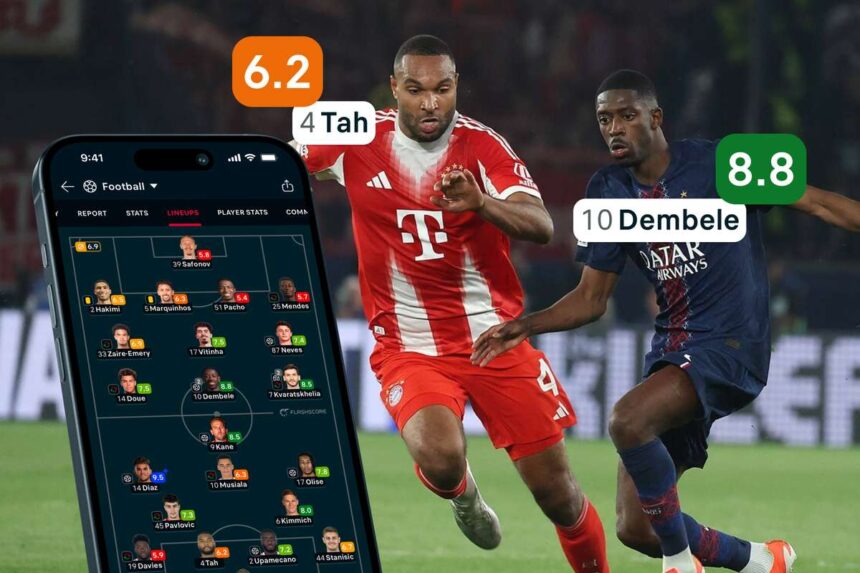
THE NEW FLASHSCORE RATING: FAIR, TRANSPARENT AND SMARTER THAN EVER IN MORE THAN 250 LEAGUES
The evolution of the Flashscore Rating has taken a significant step forward, reflecting our dedication to providing an enhanced experience for our users. With three years of refinement behind us, we are excited to unveil the new Flashscore Rating. This system is designed to cater to both casual fans and those who delve deeply into the statistics of the game, offering a comprehensive evaluation that resonates with all levels of football enthusiasts.
Our revamped rating system integrates over 70 distinct statistics, culminating in a unified score for each player. To qualify for this rating, a player must participate in at least ten minutes of the match, with their score adjusting dynamically as the game progresses.
The Flashscore Rating operates on a fully automated basis, employing a custom algorithm that has been benchmarks against previous performances. Our sophisticated approach utilizes in-depth Opta data to ensure objectivity, eliminating any potential human bias from the equation. The process has been meticulously tested and validated by our in-house experts, along with consultations from football luminaries such as Premier League icon Petr Čech.
Robust Evaluation Criteria
What sets the new Flashscore Rating apart is its capacity to evaluate players beyond mere goals and assists. Each player’s contributions are gauged in relation to their specific responsibilities on the field. This nuanced assessment takes into account their assigned roles—be it Defending, Progression, Playmaking, or Attacking—and rates them accordingly. This ensures that players in defensive positions, like those who specialize in disrupting play, are evaluated fairly against their actual impact, instead of being measured by offensive metrics alone.
We cherish those game-defining moments and unique talents that influence a player’s performance. Consequently, these critical instances—including significant chances created or mistakes leading to goals—factor prominently in the final rating alongside other relevant statistics. Exceptional skills, such as superior dueling ability or outstanding dribbling, also contribute to the holistic assessment of a player’s impact during a match.
Comprehensive Player Profile
The new Player Card serves as a valuable resource, providing users with a wealth of information to contextualize a player’s rating. It encompasses everything from extensive statistical data to pivotal moments and exceptional traits that influenced the ultimate score.
Player Role Profiling
In our extensive evaluation framework, we delineate specific roles that players occupy to produce accurate profiles. The Goalkeeping role focuses on the capabilities of goalkeepers, assessing their shot-stopping through metrics such as saves and goals prevented, while also examining their contributions in passing, sweeping, and claiming.
The Defending role evaluates a player’s defensive efforts via actions like tackles, interceptions, and recovery of the ball, along with aerial duels, clearances, and blocked shots. Meanwhile, the Progression role honors players who drive the ball towards the opponent’s goal through progressive passes and carries, as well as entries into the final third. This multi-dimensional approach ensures that players are recognized for their worth in advancing the play.
On the offensive side, the Playmaking role captures the creativity of players active in high-stakes areas, while the Attacking role predominantly focuses on direct goal-scoring threats, incorporating metrics related to expected goals, shots, and touches inside the penalty box.
Game-Changing Moments and Player Abilities
Moreover, we factor in pivotal moments and extraordinary abilities, influencing the final rating. Some events yield strictly positive contributions, while others may result in negative impacts. For instance, a player’s effectiveness in finishing can swing their rating positively or negatively based on their conversion rates relative to expected outcomes.
The same principle applies to goalkeepers, whose shot-stopping abilities determine their ratings in much the same way, evaluating how many goals they saved in relation to the quality of the shots they faced.