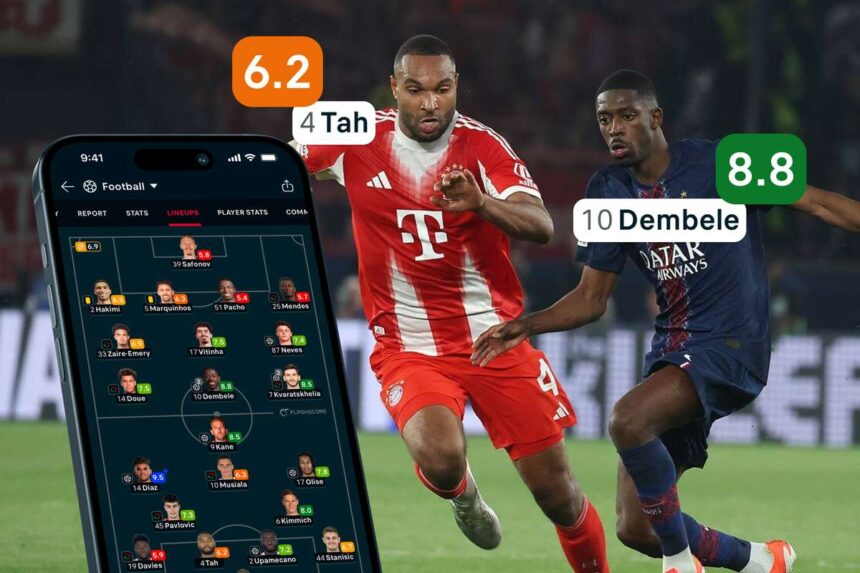
The New Flashscore Rating: A Comprehensive Evaluation System
Flashscore fans have been accustomed to an evolving football rating system for the past three years. With a commitment to continuous improvement, we are excited to introduce the latest iteration of the Flashscore Rating, designed for both casual spectators and data enthusiasts alike, making it the ultimate evaluation tool across over 250 leagues.
Algorithm and Methodology Behind the New Rating
The revamped Flashscore Rating integrates more than 70 distinct statistics, consolidating them into a singular grade that requires players to be on the pitch for a minimum of 10 minutes in order to receive scoring. This grade adjusts dynamically throughout the game, reflecting real-time performance.
To achieve this, Flashscore has developed a fully automated system, leveraging extensive historical performance data as well as in-depth analytics provided by Opta. This method ensures that the grading process remains objective and free from human bias. The algorithm has been rigorously tested in collaboration with industry experts, including Premier League legend Petr Čech.
Comprehensive Player Assessments
Central to the Flashscore Rating is an approach that goes beyond mere goals and assists; it evaluates players in relation to their specific roles on the field. Acknowledging that player responsibilities can vary greatly, the system categorizes players into roles such as Defending, Progression, Playmaking, or Attacking, ensuring that each athlete is assessed fairly according to their contributions.
This refined profiling framework guarantees that a defensive midfielder whose strengths lie in averting opposition attacks is not evaluated using offensive metrics, thereby providing a more accurate reflection of their impact on the game.
Highlighting Key Moments and Skills
Flashscore places great importance on crucial game-changing moments. These aspects significantly influence the overall rating, with favorable actions such as creating significant chances or executing critical tackles enhancing a player’s score. Conversely, mistakes leading to goals or missed opportunities can adversely affect their ranking.
Exceptional abilities, such as proficiency in dueling or exquisite dribbling, also play a pivotal role in shaping a player’s final evaluation.
In-Depth Player Card Information
The culmination of this comprehensive assessment is presented in the new Player Card. Users will find an array of relevant information that contextualizes the player’s rating, encompassing detailed statistics, pivotal plays, and unique attributes that contributed to their overall grade.
Defining Player Roles and Their Metrics
The rating system distinguishes various player roles, each associated with specific performance metrics:
- Goalkeeping: Focused solely on goalkeepers, this role evaluates their shot-stopping capabilities through metrics like saves and prevented goals, while also factoring in their passing efficiency and overall presence.
- Defending: This role measures a player’s defensive contributions through tackles, interceptions, and clearances, assessing their effectiveness in thwarting opposing attacks.
- Progression: This aspect rewards players for advancing the ball towards the opposing goal, tracking metrics such as progressive passes and successful entries into the final third.
- Playmaking: It highlights players involved in crucial attacking plays, evaluating metrics like expected assists and key passes that signal an active presence in critical areas.
- Attacking: This role emphasizes direct goal threats, utilizing metrics such as expected goals, shots, and actions within the opposition’s box to assess offensive contributions.
Balancing Player Profile Combinations
Combining top-ranking roles results in specific player profiles that accurately mirror the unique qualities athletes bring to their teams. For instance, a midfielder who excels in both Defending and Progression might be categorized as a formidable ball-winning number 6, while a player who stands out in Playmaking and Progression may be recognized as a creative number 8.
Influential Moment Assessments
These critical moments, dubbed ‘bonuses’, can significantly alter a player’s rating. While some metrics, such as Winning Goals, are strictly positive, others like Errors Leading to Goals can negatively impact assessments. Additionally, certain abilities can variably influence ratings based on performance outcomes.
Concluding Thoughts on the Flashscore Rating
The Flashscore Rating aims to provide a sophisticated, fair, and transparent evaluation of players’ performances, utilizing a comprehensive framework that accounts for their specific roles and significant moments within the match. This revolutionary approach seeks to enhance the understanding and appreciation of football, delivering valuable insights to fans and analysts alike.