“`html
The New Flashscore Rating: Fair, Transparent and Smarter Than Ever in More Than 250 Leagues
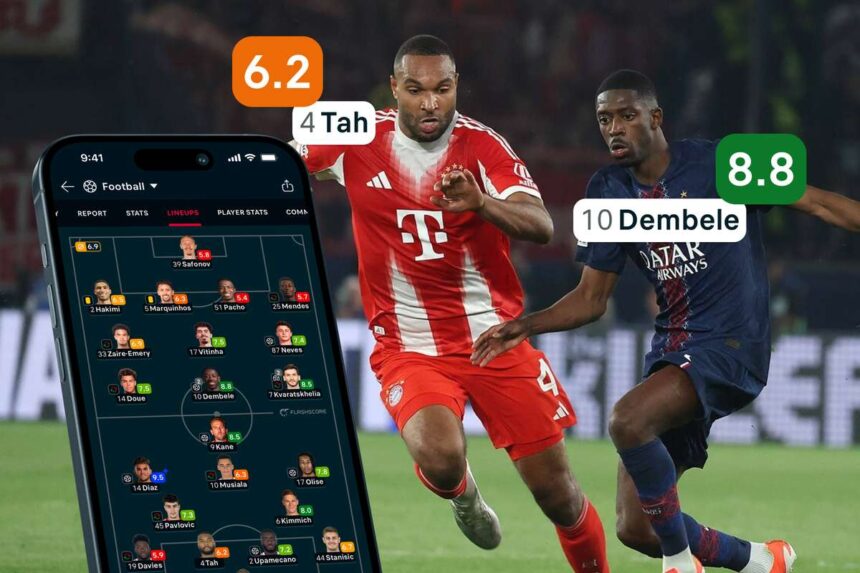
Flashscore users and fans have been familiarizing themselves with the football rating for three years. As with every feature in our application, relentless improvement has been our guiding principle, and we are now excited to unveil the revamped Flashscore Rating. This new rating serves as the ultimate evaluation tool, catering to both casual fans and those who revel in data analysis.
An Overview of the Flashscore Rating
The new Flashscore Rating synthesizes over 70 different statistics into a single score. To receive a rating, a player must participate in at least 10 minutes of a match, with the score dynamically updating as the game progresses. This system is completely automated, benchmarked against historical performances, and relies on comprehensive data provided by Opta. This ensures that the rating is objective and free from any human bias. Our dedicated team developed a unique algorithm that has undergone thorough testing alongside various experts, including Premier League legend Petr Čech.
Beyond Goals and Assists: Comprehensive Player Evaluation
The Flashscore Rating considers an array of factors beyond mere goals and assists. Each player is assessed based on their specific role on the field, which can significantly vary regardless of their position in the lineup. We categorize players into roles such as Defending, Progression, Playmaking, or Attacking, and evaluate them according to these classifications.
The Importance of Context in Player Profiling
This detailed and adaptive profiling ensures that players are judged by their actual contributions to the team. For instance, a midfielder known for his defensive capabilities will not be measured against parameters typically applied to forwards. Our intent is to eliminate the inflation of ratings for goal scorers who may not contribute defensively.
Impactful Moments: Shaping the Ratings
At Flashscore, we recognize the significance of game-changing moments—these elements greatly influence the overall player rating. Noteworthy occurrences such as major chances created or mistakes leading to goals are factored into the rating alongside conventional statistics. Exceptional attributes, like proficiency in duels or advanced dribbling skills, are also considered and impact the final evaluation.
Understanding the Player Card
The culmination of these measurements is showcased in the new Player Card, where users can explore detailed contextual data, essential moments, and standout characteristics that influenced the rating. This rich informational resource empowers fans to understand the dynamics behind each player’s performance rating.
Defining Key Roles in Player Evaluation
The framework of player roles provides a clear structure for evaluation:
- Goalkeeping: Exclusively applies to goalkeepers, evaluating their shot-stopping skills in terms of both volume of saves and quality of goals prevented, while also acknowledging their contributions to passing and defensive coverage.
- Defending: Measures the player’s effectiveness in defensive contributions, including intercepting passes, tackling, and clearing threats.
- Progression: Assesses how well players move the ball towards the opponent’s goal through progressive passing and effective carries.
- Playmaking: Identifies players who create opportunities by measuring expected assists and critical passes.
- Attacking: Focuses on the direct threat level a player poses through scoring opportunities and actions in the penalty area.
Dynamic Player Profiles
Combining the highest-ranking roles allows for the creation of specific player profiles. For instance, a midfielder dominating in both Defending and Progression could be identified as a ball-winning number 6, whereas one excelling in Playmaking and Progression may be labeled as a playmaking number 8. This ensures the rating accurately reflects a player’s assigned responsibilities and performance quality.
Game-Changing Bonuses and Their Ramifications
Player ratings are further influenced by ‘bonuses’ that account for impactful moments and abilities. Certain bonuses carry strictly positive implications (like scoring important goals or executing crucial tackles), while others hold negative weight (such as errors leading to goals or significant chances missed). Furthermore, some abilities can tilt the rating either direction, impacting the final score based on their effectiveness.
Defining Success in Finishing and Shot Stopping
The metrics for evaluating finishing and shot-stopping skills provide a nuanced perspective:
- Finishing: Assesses how effectively players convert their chances relative to their position. It employs a comparison between the post-shot scoring probability and the likelihood based on shooting position, indicating whether players are outperforming or underperforming expectations.
- Shot Stopping: Evaluates how well goalkeepers save shots in relation to the quality of the attempts they face, analyzing the difference between expected goals and actual goals conceded to determine their efficiency under pressure.
“`