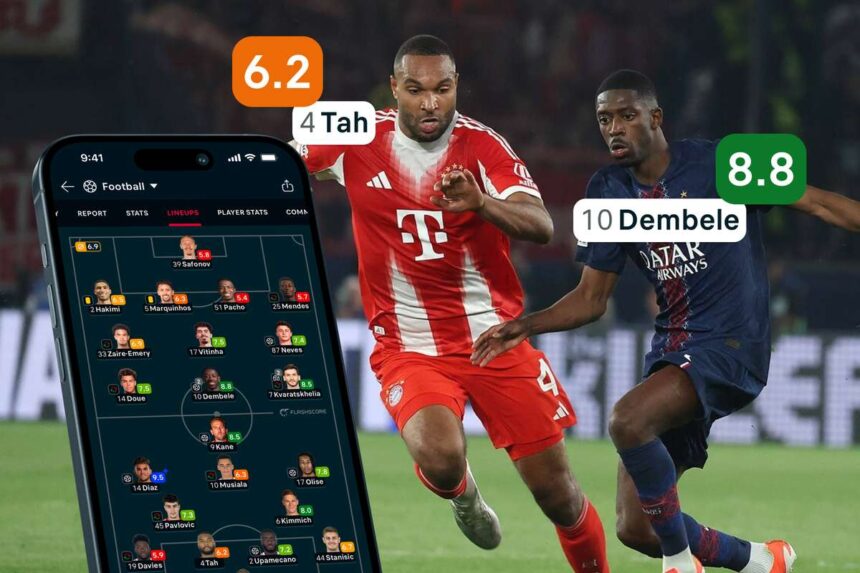
THE NEW FLASHSCORE RATING: FAIR, TRANSPARENT AND SMARTER THAN EVER IN MORE THAN 250 LEAGUES
For the past three years, Flashscore users and football enthusiasts have become familiar with our football rating system. In our continuous effort to enhance the user experience, we are proud to introduce the new Flashscore Rating. This rating is designed for both casual fans of football and those who wish to dive deeply into the intricacies of data.
Automated Evaluation Based on 70 Statistics
The new Flashscore Rating synthesizes over 70 vital statistics into a single, comprehensive grade. To ensure a player receives a rating, they must be on the pitch for a minimum of 10 minutes, and their score will evolve as the match progresses.
Objective and Transparent Analysis
Developed through a fully automated process, this rating is benchmarked against historical performances and driven by comprehensive Opta data, ensuring objectivity without human bias. Our dedicated team created a sophisticated algorithm for this purpose, rigorously testing the rating in collaboration with football experts, including Premier League icon Petr Čech.
A Holistic Approach to Player Metrics
The Flashscore Rating considers far more than just goals and assists. Players are evaluated based on their specific roles on the field, allowing for a nuanced appraisal of their contributions. Regardless of their position in the starting lineup, players’ actual responsibilities can differ significantly. Therefore, we assess whether they take on a Defending, Progressing, Playmaking, or Attacking role, or a combination of these, to assign an appropriate rating.
Dynamic Player Profiling
This comprehensive and adaptable player profiling ensures that all individuals are rated according to their actual contributions to the team. For instance, a defensive midfielder excelling at disrupting play won’t be judged through the lens of attacking statistics, thus avoiding the overvaluation of solely goal-scoring players.
Key Game-Changing Moments
Flashscore recognizes that pivotal moments and abilities are instrumental in shaping the final rating. Factors like creating significant chances or committing errors that lead to goals critically influence the score, as do exceptional skills such as dominating duels or exemplary dribbling abilities.
The New Player Card
All of this invaluable data culminates in the revamped Player Card, where each user can find essential information to understand the context behind a player’s rating—ranging from in-depth contextual statistics to key moments and standout traits that have contributed to the final score.
Understanding Player Roles and Metrics
Our player profiling structure breaks down the roles as follows:
Goalkeeping Role: Available exclusively to goalkeepers, assessing their shot-stopping skills through volume (saves) and quality (goals prevented), alongside their passing contributions, sweeper capabilities, and commanding presence.
Defending Role: Evaluates the extent of a player’s defensive efforts via ball-winning actions such as tackles, interceptions, and recoveries, in addition to successful aerial duels, clearances, and blocked shots.
Progression Role: Rewards players for advancing the ball towards the opposing goal, measured through progressive passes and carries across the pitch, culminating with entries into the final third.
Playmaking Role: Identifies players engaged in creating scoring opportunities in critical areas, utilizing expected assists and key passes to gauge chance creation, as well as successful passes into the penalty area.
Attacking Role: Primarily centered on direct goal threats through expected goals, shots taken, and touches within the box, while including the context from won dribbles and offensive aerial duels.
Creating Comprehensive Player Profiles
The intersection of these roles creates distinct player profiles. For example, a midfielder proficient in defensive duties and progression earns the label of a ball-winning Number 6, while one excelling in playmaking and progression is categorized as a playmaking Number 8. This method guarantees that the rating accurately represents a player’s true responsibilities and their success in fulfilling them.
Game-Changing Bonuses Affecting Ratings
Additionally, specific positives, such as decisive goals or crucial defensive tackles, and negatives, like errors leading to goals or missed high-stakes opportunities, help define the player’s ultimate rating. Certain abilities, particularly finishing and shot-stopping, can have a variable impact: outstanding performance in these areas enhances the rating, while poor execution can diminish it.
Conclusion
By emphasizing a multifaceted analysis, the new Flashscore Rating offers a clearer, fairer portrayal of player performances across various leagues, ensuring every player is recognized for their unique contributions on the pitch.