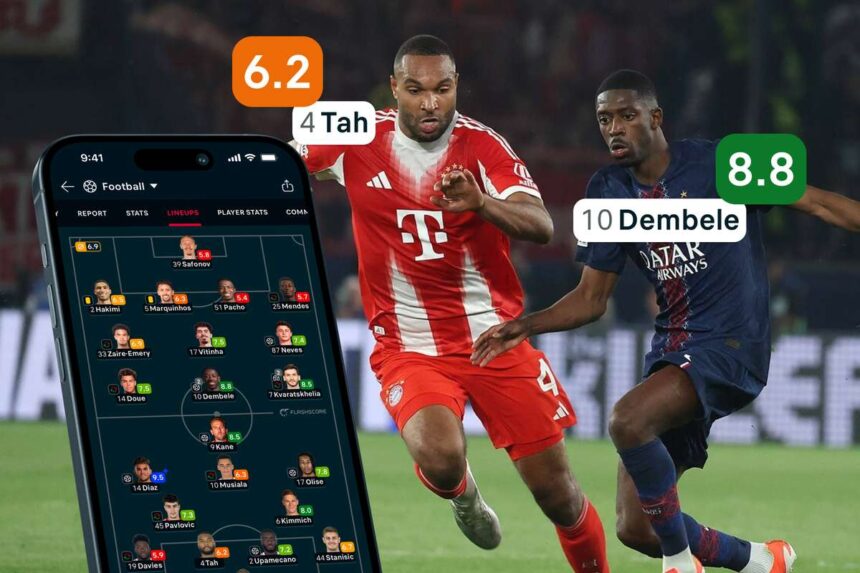
THE NEW FLASHSCORE RATING: FAIR, TRANSPARENT AND SMARTER THAN EVER IN MORE THAN 250 LEAGUES
For the past three years, Flashscore has catered to the needs of football fans with its unique rating system. However, progress is essential, and thus, we are thrilled to unveil the revamped Flashscore Rating. Whether you’re a casual observer of the sport or a data enthusiast, this innovative evaluation caters to all.
The new Flashscore Rating encapsulates over 70 diverse statistics into a singular grade. A player must participate for a minimum of ten minutes to receive a rating, which adapts as the match unfolds, ensuring accuracy and relevance throughout the game.
This new system is entirely automated, drawing comparisons against historical performances and utilizing comprehensive Opta data—remaining objective and free from human bias. We have crafted a proprietary algorithm, validating our ratings with insights from experts, including Premier League icon Petr Čech, ensuring a high standard of reliability.
Beyond merely considering goals and assists, the Flashscore Rating employs a multifaceted assessment based on a player’s specific role on the field, thus acknowledging the variance in responsibilities as per their position in the lineup. We analyze whether a player is primarily Defending, Progressing, Playmaking, or Attacking, and rate them accordingly.
This in-depth profiling guarantees that each player is evaluated based on their actual contribution to the team. For instance, a defensive midfielder excelling in disrupting play will not be unfairly compared to an attacker. This approach eliminates the practice of over-valuing goalscorers in our ratings.
At Flashscore, we recognize that pivotal moments define matches, and these moments directly influence final ratings. Significant actions, such as creating considerable scoring opportunities or committing critical errors leading to goals, play a decisive role in shaping the ratings as do exceptional skills like dominance in confrontations or elite dribbling.
The newly designed Player Card consolidates all pertinent information needed to grasp the context underlying a player’s rating. Users can explore extensive contextual data, key moments, and notable attributes that contribute to the final grade.
DEFINED PLAYER ROLES AND MEASUREMENTS
Understanding the roles utilized in player profiling is crucial to grasping the measurement criteria:
The Goalkeeping role is exclusive to goalkeepers, focusing on their shot-stopping capabilities, including the volume of saves made and the quality of goals they manage to prevent. It also assesses their passing contributions and overall gameplay presence.
The Defending role evaluates a player’s defensive contributions through metrics such as tackles, interceptions, and ball recoveries, as well as successful aerial duels and shot blocks.
Players engaged in the Progression role are rewarded for advancing the ball towards the opponent’s goal, measured through progressive passes and carries across the pitch, particularly those leading into the final third.
Meanwhile, the Playmaking role identifies those players who operate effectively in high-stakes situations, accounting for expected assists and critical passes made within the penalty area.
Lastly, the Attacking role concentrates primarily on direct threats to goal, including analytics related to expected goals, shooting attempts, and player interactions in the box, integrated with successful dribbles and offensive aerial confrontations for added context.
When these roles come together, they form a distinct player profile. For example, a midfielder excelling in Defense and Progression will be characterized as a ball-winning number six, whereas one who showcases Playmaking and Progression skills will be categorized as a playmaking number eight, ensuring the rating reflects their actual contributions accurately.
MOMENTS AND ABILITIES THAT CHANGE THE GAME
Situational achievements, or ‘bonuses’, substantially influence final ratings, wherein some actions yield purely positive impacts (such as winning goals or crucial tackles), and others could be detrimental (like mistakes leading to goals or missed significant chances). Certain abilities can swing ratings in both directions; adeptness in dueling can enhance grading, while poor duel success rates can significantly detract from a player’s evaluation.
Two abilities exemplifying this dual effect are:
Finishing – This ability assesses how proficiently players score based on the quality of chances available to them, calculated by the disparity between post-shot scoring probability (xGOT) and shot quality (xG). A positive figure indicates a player is converting opportunities better than the situation suggests.
Shot Stopping – This skill measures how well goalkeepers thwart attempts compared to shot quality faced. It is determined by the difference between the post-shot scoring probability (xGOT) and the actual goals conceded. A positive difference signifies a goalkeeper’s superior performance against expectations, while a negative one indicates conceding more than anticipated based on shot qualities.