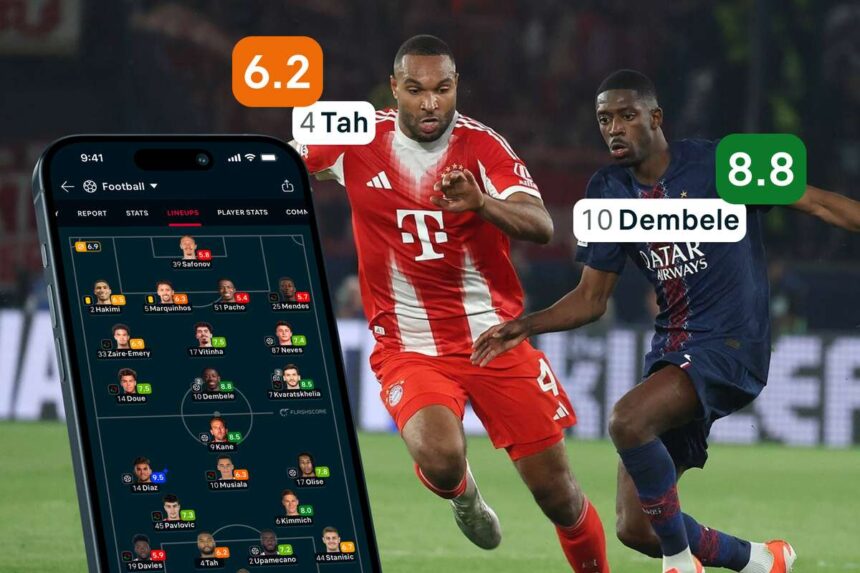
The New Flashscore Rating: Fair, Transparent, and Smarter Than Ever in Over 250 Leagues
For the past three years, Flashscore users and football enthusiasts alike have become accustomed to the platform’s football rating system. However, true to our commitment to continuous improvement, we’re excited to unveil the new Flashscore Rating. This innovative system caters to both casual fans and data enthusiasts, providing a definitive evaluation of player performances.
The new Flashscore Rating synthesizes more than 70 distinct statistics into a single, comprehensive grade. A player must participate in at least 10 minutes of a match to receive a rating, which adapts throughout the game based on ongoing performance.
Our rating system is fully automated, utilizing deep Opta data to ensure objectivity and eliminate human bias. We have developed proprietary algorithms and thoroughly tested the ratings with input from our team of experts, including Premier League legend Petr Čech.
Understanding the Flashscore Rating
The Flashscore Rating encompasses various performance metrics beyond mere goals and assists. Players are evaluated according to their specific roles on the pitch, which can vary significantly regardless of their position in the lineup. This assessment considers whether they fulfill a Defending, Progression, Playmaking, or Attacking role, or any combination thereof, allowing for a nuanced evaluation of their contributions.
This thorough and adaptable player profiling ensures that performance is assessed based on individual roles within the team. For instance, a defensive midfielder specializing in disrupting play will not be unfairly compared to attackers based solely on goal-scoring metrics.
At Flashscore, we recognize the importance of pivotal game-changing moments. Consequently, events like key chances created or significant mistakes leading to goals impact the final ratings, along with exceptional player abilities, such as dominance in duels or remarkable dribbling skills.
The New Player Card
The culmination of this algorithmic evaluation is reflected in the revamped Player Card. Each user will have access to vital information that contextualizes a player’s rating, including detailed metrics, critical moments, and standout attributes that influenced the final grade.
Player Roles and Profiling
The player roles used in our profiling are designed to measure specific contributions:
- Goalkeeping: Exclusively for goalkeepers, focusing on their shot-stopping effectiveness, save volumes, and contributions to the game, including passing and presence.
- Defending: Captures defensive actions such as tackles, interceptions, and overall box defense, measuring a player’s impact on the defensive side of the game.
- Progression: Rewards players advancing the ball toward the opponent’s goal through progressive actions, providing insight into their influence on game momentum.
- Playmaking: Identifies players engaged in creating scoring opportunities via expected assists and key passes, measuring their relevance in crucial play areas.
- Attacking: Concentrates on goal threats, taking into account expected goals, shots, and offensive contributions that shape a player’s attacking presence.
When these roles are combined, they generate a distinctive player profile. For example, a midfielder could be classified as a ball-winning number six if they excel in Defensive and Progressing roles, while a player dominating in Playmaking and Progressing could be rated as a playmaking number eight. This mechanism ensures that a player’s rating accurately reflects their genuine responsibilities and effectiveness on the field.
Game-Changing Moments and Abilities
In addition to the standard metrics, specific game-changing moments significantly impact a player’s rating. Certain actions are assigned positive value (such as Winning Goals), while others carry negative weight (like Errors leading to goals). Some abilities can affect a rating both positively and negatively; for instance, exceptional success in dueling can enhance a rating, whereas poor performance in the same area can be detrimental.
Two pivotal abilities that can swing ratings are:
- Finishing: Assesses players’ efficiency in converting chances, comparing actual goals to expected goals based on shot positions. A positive differential indicates players perform better than their positions suggest, while a negative one implies the opposite.
- Shot Stopping: Evaluates goalkeepers based on their ability to save shots relative to the quality and context of the attempts faced. A positive rating suggests they have surpassed expectations, while a negative rating indicates that they conceded more goals than their saving capabilities warranted.