BELGIUM FACES STRIKER DILEMMA AHEAD OF WORLD CUP SHOWDOWN WITH SENEGAL
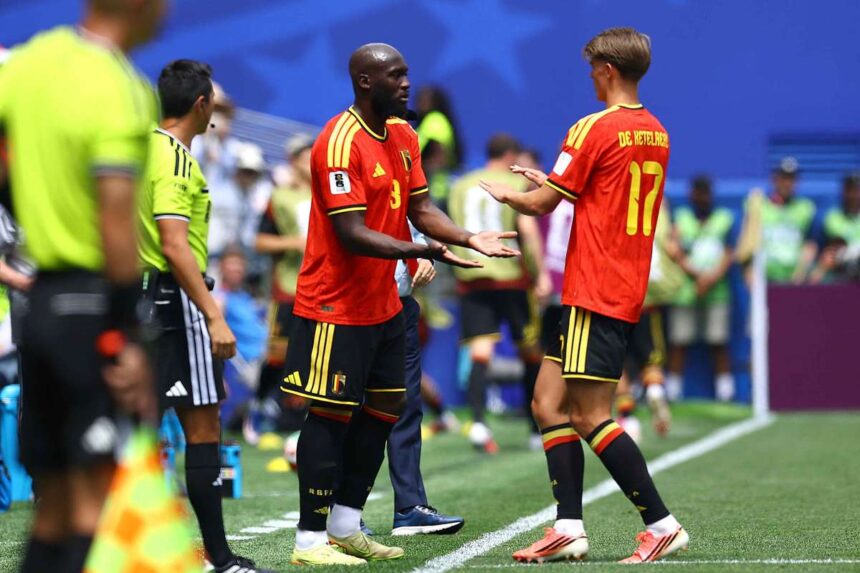
As Belgium prepares to clash with Senegal in the round of 32 at the World Cup, manager Rudi Garcia finds himself grappling with a pressing decision regarding his attacking lineup. During the team’s underwhelming group stage performance, Garcia fluctuated between deploying Charles de Ketelaere and Romelu Lukaku, two forwards with markedly different playing styles. This indecisiveness reflects a broader uncertainty within the Belgian squad.
CHARACTERISTICS OF DE KETELAERE AND LUKAKU
The variance in profiles between De Ketelaere and Lukaku poses a significant tactical question for Garcia. Lukaku, the seasoned striker, has endured a challenging season filled with injuries, managing only 64 minutes on the field for Napoli. Nonetheless, he made his presence felt early in the match against Egypt, where he was pivotal in earning an own goal from Mohamed Hany soon after he substituted onto the pitch. Despite voicing concerns about his match readiness—admitting he could only play for about thirty minutes—Lukaku was nonetheless included in the starting eleven.
In contrast, De Ketelaere’s involvement against Iran saw him put in a lackluster 73 minutes, which led to Garcia opting to reinstate De Ketelaere for the match against New Zealand. Ultimately, Belgium concluded the group stage unbeaten and at the top of their group, but the upcoming match against Senegal intensifies the need for clarity regarding who will spearhead the attacking front.
ATTACKING STRATEGIES AND SCOUTING REPORTS
In Belgium’s opening match, De Ketelaere clocked in 66 minutes but was an afterthought offensively, touching the ball merely five times in the penalty area. His replacement, Lukaku, achieved three touches—underscoring a deficiency in the team’s attacking structure. While using a false nine can occasionally open up space, successful offensive plays necessitate a chorus of attacking runs from midfielders.
Analyzing De Ketelaere’s contributions reveals a mixed performance: he completed 14 of 19 passes in the final third but managed only three attempts directed at goal. His overall stats included winning nine out of thirteen duels, with a flawless aerial duel record. However, he fell short with only a single key pass and no shots on target, raising doubts about his impact on the game.
As for Lukaku’s performance against Iran, while he demonstrated value through link-up play—contributing six successful connections out of eight—and managed ten forward passes in the final third, his struggles in one-on-one situations (only three out of nine duels won) and limited offensive output (just one shot) indicate he may not be suited for a starting role. Rather, he may serve better as a late-game impact player, introduced after cooling breaks to maximize his effectiveness.
ASSESSING BELGIUM’S PERFORMANCE
Following a convincing victory over New Zealand, the Red Devils’ displayed potential, yet questions remain about whether their overall performance accurately reflects their capability, particularly given New Zealand’s status as the weakest team in the group. For Senegal, who secured their place through a decisive 5-0 victory over Iraq, the challenge lies in fine-tuning their evident cohesion and team dynamics in the knockout stage.
FIFA WORLD CUP 2026 DETAILS
The FIFA World Cup 2026 is set to take place from June 11 to July 19 across the United States, Canada, and Mexico. This tournament marks a historic expansion, featuring 48 national teams competing at 16 state-of-the-art stadiums.